

Dajanex: California intelligence
Find what matters across California government.
Dajanex is a configurable, AI assisted platform that helps people search, analyze, and understand complex government information across connected public data sources.
Explore procurement opportunities, state spending, budget proposals, and legislation in one place. Ask questions in plain language, compare information across sources, and review the records behind each result.
Public information is available, but finding the right information is another matter.
California government information is spread across separate portals, datasets, documents, and reporting systems. Each source may be valuable on its own, but understanding the larger picture often requires hours of searching, filtering, and comparison.
Dajanex brings this information into a more connected research experience. It helps users move from a question to relevant records, useful context, and supporting source material without searching each system separately.
The platform uses AI assisted search and analysis to help people work through complex information. It does not replace professional judgment. Users remain responsible for reviewing sources, interpreting results, and deciding what comes next.
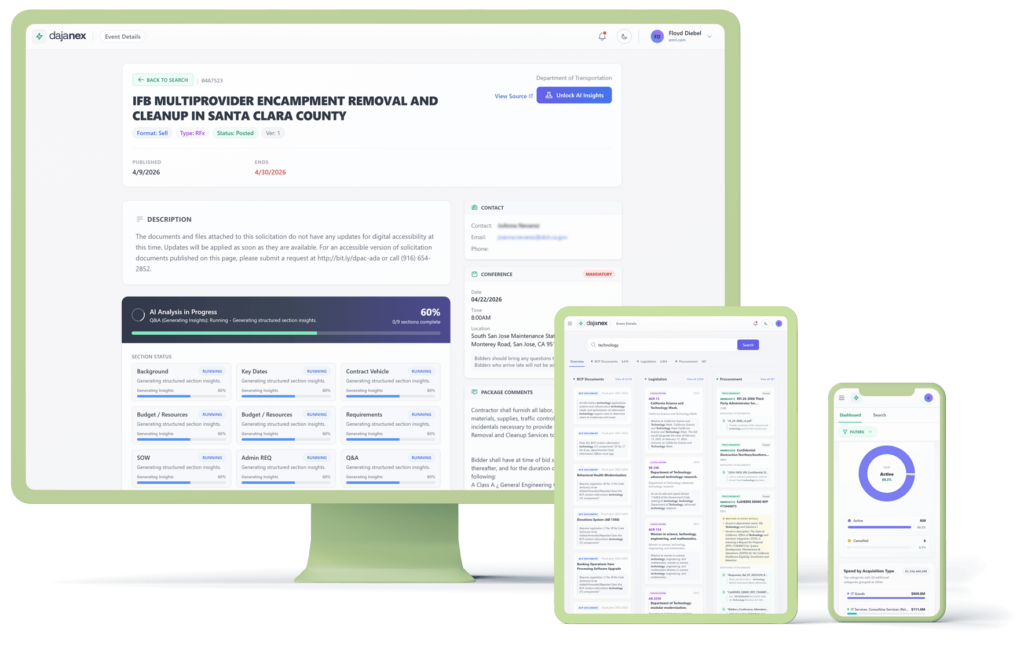
Move from questions to useful context.
Dajanex helps users work through complex information by combining plain language search, structured filters, connected data, and AI supported analysis.
Search across sources
Research information across multiple connected datasets without repeating the same search in separate systems.
Users can begin with a question, keyword, agency, topic, date, category, or other available criteria, then refine the results as the research develops.
Understand complex documents
Lengthy procurement packages, budget proposals, contracts, legislation, and supporting records can take hours to review.
Dajanex helps summarize documents, identify relevant sections, compare related materials, and surface details that may require closer attention.
Connect related information
Government activity rarely exists in isolation.
A procurement opportunity may relate to agency spending, an earlier budget request, a legislative priority, or a previous contract. Dajanex helps users follow these connections across available sources and build a more complete understanding of the issue.
Review the supporting source
Dajanex keeps results connected to the records behind them.
Users can review source material, validate important details, and apply their own professional judgment before deciding what comes next. The platform supports research and analysis. It does not replace the expertise or responsibility of the person using it.
Create an account to activate your free month of Dajanex.
Public sector intelligence
California government information is spread across separate portals, datasets, documents, and reporting systems. Each source may be valuable on its own, but understanding the larger picture often requires hours of searching, filtering, and comparison.
Unified Search
See where procurement, spending, budgets, and legislation overlap, making it easier to identify relationships that may not be visible within a single dataset.
BCP Analytics
Research California Budget Change Proposals to see where agencies are requesting funding, staffing, technology, and program support.
Legislation
Follow bills, topics, status changes, summaries, and related activity without piecing together information across multiple sources.
Cal eProcure
Search California procurement opportunities and review the agencies, dates, requirements, categories, documents, and other details associated with each solicitation.
SCPRS
Review what agencies have purchased, how much they have spent, which suppliers received the work, and where related activity may be occurring across state government.
Custom deployments
Dajanex can also serve as the foundation for a platform configured around an organization’s own data, documents, systems, workflows, and responsibilities.
Dajani works alongside agency and organizational teams to understand what information people need, where it currently lives, how it should be accessed, and what controls must remain in place.
A custom deployment may include connections to internal databases, document repositories, files, or business systems. It may also include organization specific search tools, dashboards, user roles, review processes, governance requirements, and integrations with existing technology.
The goal is not to introduce AI for its own sake. It is to make a defined body of information easier for people to search, understand, and use responsibly.